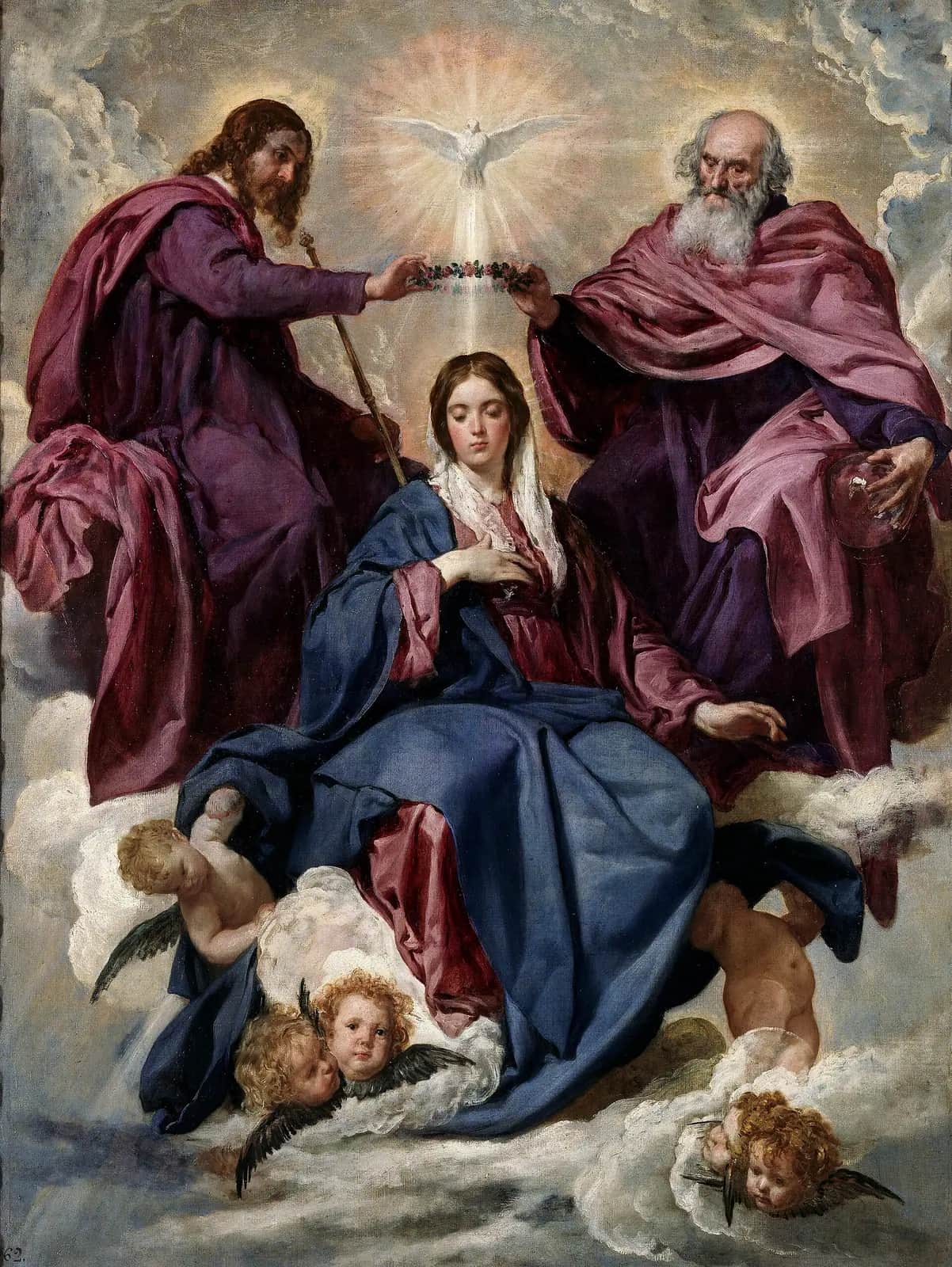
Chapter 4 — The Queen Mother
Diego Velázquez, The Coronation of the Virgin, c. 1635 · Museo del Prado · Public domainDiego Velázquez, The Coronation of the Virgin, c. 1635, Museo del Prado
From Jewish Roots of Mary, based on Brant Pitre
4.0 Opening
pp 66–68
- A kingdom needs a queen — the four marks of the gebirah
The gospel is the arrival of a kingdom — 'the empire of God' — and God promised David a throne 'for ever.' Jesus is not only a new Adam and a new Moses but a new David, so the question follows: 'If Jesus is the new Davidic king, then who is the new queen?' Pitre answers from the Old Testament's portrait of the queen mother (gebirah, 'great lady') under four heads: the queen is the king's mother, not his wife; she reigns with the king; she is a powerful intercessor; and she appears in the prophecies of the future king. He then imagines first-century Jewish women asking not only 'Who will be the mother of the Messiah?' but 'Who will be the new queen mother?'
pp 66–73
Verses introduced here: 2 Samuel 7:12
- A kingdom needs a queen — the four marks of the gebirah
4.1 The Queen Mother in Ancient Israel
pp 68–74
The Queen Is the King's Mother
- In David's kingdom, who was the queen — and why?
Not the king's wife (kings had many) but the king's mother — the gebirah, 'great lady.' Solomon rose, bowed, and set Bathsheba on a throne (Hebrew kisse', the very word used of Solomon's own throne in the previous verse — 'seat' in some translations undersells it, p 69) at his right hand, and she carried petitions to him. Almost every king of Judah is introduced with the name of his mother (p 75).
pp 68–73
- 'Throne,' not 'seat' — kisse' and thronos in 1 Kings 2:19, and the Bathsheba reversal
Some English versions say Solomon had a 'seat' brought for his mother. The Hebrew is kisse', the Greek thronos — 'the exact same word used in the previous verse to describe Solomon's throne.' 'It is hard to overestimate the significance of this passage.' Pitre also sets it beside 1 Kings 1: while David lived, Bathsheba bowed and did obeisance to the king and called him 'my lord'; once her son reigns 'the roles are reversed' — the king rises, bows to her, and enthrones her at his right hand. The obvious implication is that the king's mother, not his wife, is queen.
pp 69–70
The Queen Mother Reigns with the King
- The Old Testament root of asking for Mary's intercession.
The queen mother was the kingdom's chief intercessor. Adonijah asks Bathsheba to petition Solomon, certain 'he will not refuse you'; Solomon rises and seats her at his right hand. Pitre adds the honest qualifier that this particular request — for Abishag, a veiled claim on the throne — was refused and Adonijah executed; 'despite Solomon's abuse of his power,' the episode shows the queen mother's office as royal advocate (p 71). Asking the Queen Mother to bring a request to the King is the biblical pattern behind Marian intercession.
pp 70–71
- The right hand means shared authority — Psalm 110:1, the crown of Jeremiah 13:18, an office not a title
The queen mother 'held an official position in the kingdom, second in rank only to the king himself.' Two symbols show it. She wore a crown: Jeremiah tells 'the king and the queen mother' together to humble themselves, for their crowns are coming down. And she sat or stood at the king's right hand, as Psalm 45 pictures the queen 'in gold of Ophir' — Old Testament scholars agree this queen is the king's mother. The right hand means 'a share in his authority,' just as the king who sits at God's right hand (Psalm 110:1) shares in God's authority. After the monarch himself, she has 'the place of highest honor.'
pp 70–71
The Queen Mother Appears in Prophecies of the Future
- Whoever Immanuel is, his mother is the queen mother — and Micah 5 as the oldest reading of Isaiah 7
Pitre steps around the old debate over Isaiah 7:14 — the meaning of the 'sign,' the sense of 'almah, whether the child is Hezekiah or a future king — with one observation: 'However one interprets the prophecy, the maiden is the mother of the future king. As such, the mother of Immanuel would by definition also be the queen mother.' Then Micah: several scholars hold that Micah's prophecy of the woman who 'gives birth' to the Bethlehem ruler is based on Isaiah 7, which makes it 'the most ancient Hebrew interpretation of the birth of Immanuel that we possess' — and it reads Isaiah 7 of the Messiah, whose origin is 'from days of eternity' and whose human mother is 'she who gives birth.'
pp 72–73
Verses introduced here: 1 Kings 1:16 · 1 Kings 2:17 · 1 Kings 15:1 · 1 Kings 15:13 · Psalm 45:9 · Psalm 110:1 · Jeremiah 13:18 · Micah 5:2 · James 5:16 · Revelation 5:8
- In David's kingdom, who was the queen — and why?
4.2 Mary the New Queen
pp 74–81
The Gospel of Matthew: The Mother of Immanuel
- Mary's name in Matthew's genealogy is the queen-mother formula; Joseph 'son of David' makes her a royal wife
Why is a woman named at the end of a royal genealogy, when 'Hebrew women were not usually included'? Because in the Jewish Scriptures one kind of woman is always named when a king comes to the throne: his mother. 'Almost every time a new king begins to reign, the name of his royal mother is given' (1 Kings 14:21; 15:1–2; 2 Kings 8:25–26, and on through the kings of Judah). Matthew's 'Joseph the husband of Mary, of whom was born Jesus' follows the formula. And Matthew 1:18–23 identifies Joseph as 'son of David' and Mary as mother of Immanuel: 'As the legal wife of Joseph the son of David and the mother of Immanuel, from an ancient Jewish perspective, Mary is the royal queen mother.'
pp 74–76
- The logic that makes Mary the Queen Mother.
Jesus is the new David, given 'the throne of his father David.' If he is the Davidic King, his mother holds the Davidic office of queen mother. Elizabeth already grants the royal title, and Revelation crowns the Woman with twelve stars.
pp 74–81
The Gospel of Luke: The "Mother of My Lord"
- Elder Elizabeth honours younger Mary; 'my Lord' is a Davidic — and perhaps divine — title
Elizabeth is Mary's older kinswoman, and 'it would have been unheard of for an older relative to honor a younger cousin in this way — unless of course the younger person was royalty.' Her words, 'the mother of my Lord,' echo the court's address to the Davidic king as 'my lord' (2 Samuel 24:21; Psalm 110:1). Pitre then cites the Jewish scholar Amy-Jill Levine, who takes kyrios here as a divine title: 'Mary is not just the mother of the messianic king; she is also the mother of the divine Lord.' The Theotokos section later in the chapter rests on this.
pp 76–77
- The Magnificat is throne language
Three observations. When Mary says God 'exalted those of low degree,' she is 'referring first and foremost to herself,' having just spoken of 'the low estate of his handmaiden' — 'Mary is the personal embodiment of the poor and the lowly in Israel.' 'He has put down the mighty from their thrones' 'is royal language. It is kings and queens who sit on thrones, and when they are put down from their thrones, others must take their place.' And 'all generations will call me blessed' echoes Psalm 45:17, where the king's name is celebrated in all generations. So the Magnificat implies 'that both she and her son have been exalted to sit upon the thrones of the Davidic king and his mother.'
pp 77–78
The Book of Revelation: The Queen "in Heaven"
- The crown of twelve stars, Revelation 12 built on Isaiah 7, and a heavenly king implies a heavenly queen
A crown in antiquity was 'one of the symbols of royal identity and authority,' and this one is of twelve stars, 'which clearly symbolize the twelve tribes of Israel' (Genesis 37:9–10): the Woman is 'the queen of the people of God,' her crown 'a share in Christ's kingship.' Pitre's table sets Isaiah 7:13–14 against Revelation 12:1–2, 5 — a sign in the height / in heaven; the virgin with child / the woman with child; she will bear a son / she bore a son — 'even clearer in Greek.' Three consequences: the Woman is an individual (only one virgin conceived the Messiah); John of Patmos read Isaiah 7 messianically as Matthew did; and the mother of Immanuel is the royal queen mother. Finally, the Woman stands 'in heaven' as her Son is 'caught up' to the throne: 'Just as Jesus is a heavenly king… so Mary, Jesus' mother, is a heavenly queen' — 'the queen of the cosmos,' in a Protestant scholar's phrase.
pp 79–81
Verses introduced here: Genesis 37:9 · Psalm 45:17 · Matthew 1:16 · Matthew 1:23 · Matthew 1:25 · Luke 1:32 · Luke 1:36 · Luke 1:52
- Mary's name in Matthew's genealogy is the queen-mother formula; Joseph 'son of David' makes her a royal wife
4.3 Mother of "God with Us"
pp 81–89
Mother of God
- 'Mother of God with us' — and why honoring her isn't worship.
Isaiah's virgin bears Immanuel, 'God with us,' which Matthew applies to Jesus. Because her Son is God-with-us, Mary is rightly the 'Mother of God' — a claim about who Jesus is. And honoring the queen mother is not worship. Pitre's criterion is precise (p 88): in ancient Judaism and Christianity the essence of worship was sacrifice; honour, petition and praise can all be given to human beings, but sacrifice is offered to God alone. That is why Epiphanius condemned the Collyridians, who offered the eucharistic bread to Mary, while insisting she be honoured — 'Mary is to be held in honor, but the Lord is to be worshiped!'
pp 81–89
- Theotokos — Athanasius, Gregory Nazianzen, Ephesus 431, what 'Mother of God' does not mean, and the word assembled from Matthew 1:23
Athanasius, defender of Nicaea and first to list the twenty-seven New Testament books, gives one of the earliest indisputable uses of 'Mother of God' — inside a treatise defending Jesus' divinity. Gregory Nazianzen: 'If anyone does not admit that holy Mary is Mother of God, he is cut off from the Godhead.' The Council of Ephesus (431) proclaimed it: 'the premier example of how ancient Christians' beliefs about Mary were ultimately based on what they believed about Jesus' (CCC 466, 495). The title does not mean Mary is equal to or greater than God, or not fully human, or mother of the Trinity: 'she is a mere human being, a creature,' mother of the divine Son who became man. And the word itself is biblical: theos, 'God,' and tokos from tiktō, 'to bear,' are both in Matthew 1:23 — 'a virgin shall… bear (tiktō) a son… God (theos) with us.' 'There it is, right there, on the first page of the New Testament!'
pp 81–84
Veneration and Intercession
- 'Pray for one another' — why stop in heaven? and the earliest recorded prayers to Mary
Pitre's New Testament warrant for asking Mary's intercession is short. Even secular nations honour their leaders, and those who need something from a leader ask the people closest to him. Scripture commands Christians to 'pray for one another' (James 5:16) — 'Why should such prayers cease in heaven (cf. Revelation 5:8)?' — and Mary the queen is alive in heaven (Revelation 12:1). The early Church drew the conclusion: an anonymous Egyptian papyrus prayer of the third or fourth century — 'We take refuge in your mercy, Mother of God. Do not disregard our prayers in troubling times' — Gregory Nazianzen's account of the virgin Justina imploring Mary's help, Sozomen's report of healings credited to 'Mary, the Mother of God,' and John Damascene's 'Queen over all created things.' The link runs from Jesus' divinity, to Mary as Mother of God, to asking her prayers.
pp 85–86
- 'Our Lady' comes from Judaism; the Collyridians; sacrifice is the line between honour and worship
'Our Lady' is Greek kyria, a royal 'Lady,' the queen. 'Mary is Our Lady… because Jesus actually is king of the universe — not because ancient Christians sold out to paganism. There was no need to borrow the idea of a queen from paganism, since they had already gotten it from Judaism.' The Catechism's summary of the Assumption calls her 'exalted by the Lord as Queen over all things' (CCC 966, in the words of Lumen Gentium 59, which builds on Pius XII's 1950 definition). The one recorded group who did worship Mary, the Collyridians, offered her the sacrificial loaf (kollyra) of the Eucharist, and Epiphanius condemned them with the very Jeremiah passage the Baptist pastor used on Pitre: 'Mary is to be held in honor, but the Lord is to be worshiped!' The criterion is sacrifice: in ancient Judaism and Christianity 'the essence of worship was sacrifice'; honour, petition and praise can all be given to humans. Protestants, whose worship is doxology without sacrifice, therefore read Catholic praise of Mary as idolatry — 'one of the main reasons' the two sides talk past each other.
pp 86–89
- 'Mother of God with us' — and why honoring her isn't worship.