Chapter 2 — The New Eve
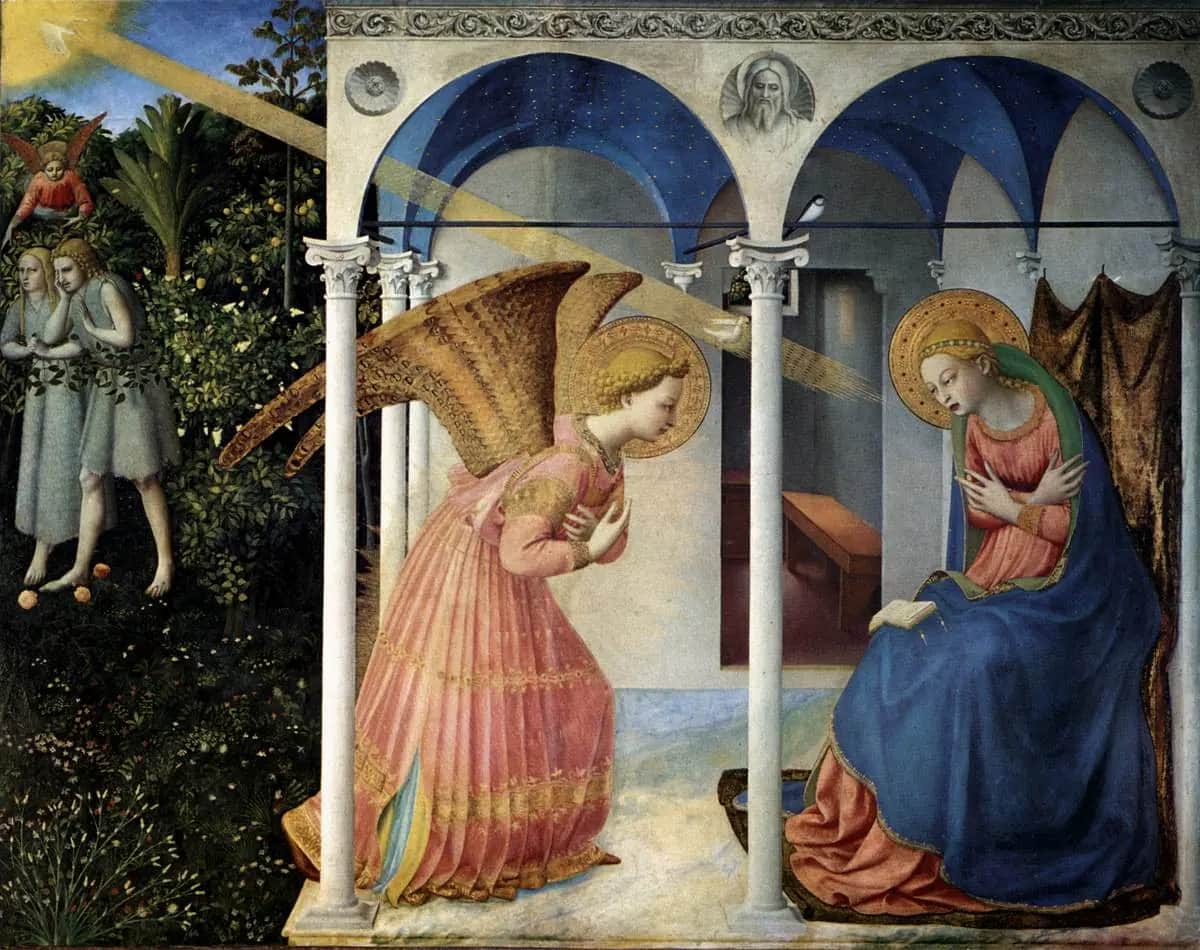
Fra Angelico, The Annunciation, c. 1440 · Convent of San Marco, Florence · Public domainFra Angelico, The Annunciation, c. 1440, Convent of San Marco, Florence
From Jewish Roots of Mary, based on Brant Pitre
2.0 Opening
pp 19–21
- What the Gospel is — undoing the first sin; Jesus the Last Adam
The chapter opens by widening the Gospel. Forgiveness of sins is essential (Matthew 26:28), but the good news is about the forgiveness of 'the very first sin — the sin of Adam and Eve — through which suffering and death came into the world.' Paul's two texts make Jesus the 'last Adam' whose obedience restores the righteousness Adam lost, and grace has 'the power to actually make human beings righteous' — Christ did not die so that God could pretend we are righteous. Then the pivot on which the chapter turns: 'If Jesus is the new Adam, then who is the new Eve?'
pp 19–20
Verses introduced here: Romans 5:18 · Romans 5:19 · 1 Corinthians 15:45
- What the Gospel is — undoing the first sin; Jesus the Last Adam
2.1 The Woman in Eden
pp 21–27
Adam and Eve Are Created "Very Good"
- Created immortal as well as sinless — the tree of life
Pitre treats immortality as a second gift alongside moral goodness. God tells the couple they may 'freely eat' of every tree, which includes the tree of life whose fruit lets them 'live for ever.' Only after the fall are they barred from it. So Adam and Eve before the fall were fully human, sinless, and offered unending life; death is a loss, not the design. The point returns twice: a sinless Mary is no less human than unfallen Eve (p 39), and the incorruptible Ark points to a body kept from the grave (pp 46, 63).
pp 21–22
- Eve was created 'very good' — why that matters for Mary.
Genesis says the first humans were made 'very good' — a Hebrew phrase meaning morally good, without sin — and given the tree of life. Tellingly, the woman is named 'Eve' only after the fall; before it she is simply 'Woman.' The New Eve is likewise 'Woman,' made in that original grace.
pp 21–23
- Mary as the New Eve — the founding text and its logic.
God sets enmity between the serpent and 'the woman,' whose seed will crush his head — fulfilled when Mary's Son conquers Satan by the cross. Ancient Jewish tradition already held that death came into the world through a woman; the New Eve reverses it, paired with Christ the New Adam.
pp 21–27
Adam and Eve Fall Together
- Adam and Eve fall together — 'immah, 'who was with her,' and the four losses of the Fall
'Contrary to what some artistic depictions suggest, Eve is not alone when she commits the first sin.' Genesis says she gave the fruit 'to her husband, who was with her' (Hebrew 'immah). Adam and Eve fall together: 'Eve cooperates with Adam, and Adam cooperates with Eve. Neither acts in isolation.' Both suffer the consequences — pain in childbearing, fruitless toil, 'to dust you shall return,' and exile from the tree of life so that they can no longer 'live for ever.' They lose 'the gift of the original goodness and immortality in which they were created.'
pp 22–23
The Battle Between the "Serpent" and the "Woman"
- Both sides strike — one Hebrew verb, and Genesis 4 as commentary on Genesis 3:15
The same Hebrew verb, shuph, describes both blows in Genesis 3:15: the seed crushes the serpent's head and the serpent strikes his heel. 'The mysterious thing about the battle is that both sides appear to lose.' Pitre's image: crushing a snake's head is the safe way to kill it, but 'if you try to step on its head, you take a fairly big risk of being struck on the heel before killing it.' The next chapter of Genesis reads the oracle spiritually: sin is a beast 'lurking at the door' waiting to strike Eve's son Cain, who must 'master' it.
pp 24–25
- What 'enmity' actually means in Genesis 3:15.
The Hebrew for 'enmity' denotes lethal hostility — the language of blood-feud and war. The verse sets up a four-party battle: the serpent and his seed against the woman and her seed, which ancient Jews read as the war with the devil. The woman's offspring crushes the serpent's head.
pp 24–25
Eve in Ancient Jewish Tradition
- Ancient Jews said the serpent was Satan — and that Eve's sin was inherited
Genesis names only 'the serpent,' but Jewish writings of the first century identify him. The Book of Wisdom: it was 'through the devil's envy that death entered the world.' The Life of Adam and Eve: the devil spoke to Eve 'through the mouth of the serpent.' The same writings hold that the first sin is passed to all descendants who were not personally guilty — Sirach ('from a woman sin had its beginning, and because of her we all die'), Pseudo-Philo, and 4 Ezra ('O Adam, what have you done?'). These texts 'lay the foundations for what would later come to be known as the doctrine of original sin.'
pp 25–26
- The Protoevangelium is Jewish soil — 1 Enoch and Targum Neofiti on Genesis 3:15
Christians call Genesis 3:15 the 'First Gospel,' the Protoevangelium; Pitre shows the reading is Jewish before it is Christian. 1 Enoch, 'very popular among Jews in the first century,' identifies the Messiah with the Son of Man and links him to the woman: 'For the offspring of the mother of the living was concealed from the beginning.' Targum Neofiti paraphrases Genesis 3:15 of the woman's sons who will 'make appeasement in the end, in the day of King Messiah.' So the Messiah was already being read as the 'offspring' of Eve, 'the mother of all living' — and the Christian tradition 'is actually rooted in Jewish soil.'
pp 26–27
Verses introduced here: Genesis 1:31 · Genesis 2:9 · Genesis 2:16 · Genesis 2:23 · Genesis 3:1 · Genesis 3:6 · Genesis 3:14 · Genesis 3:16 · Genesis 3:22 · Genesis 4:7 · Numbers 35:21 · Wisdom 2:24 · Sirach 25:24 · Ezekiel 25:15 · John 12:31 · Revelation 12:17
- Created immortal as well as sinless — the tree of life
2.2 Mary the New Eve
pp 27–36
The Wedding at Cana and the "Woman" of Genesis
- Is 'Woman' rude? — no parallel exists, and Brown and Crossan agree what it means
Pitre does not argue the point on his own authority. First the datum: 'We have no other examples of a Jewish man addressing his own mother this way.' Then the witnesses: a Protestant scholar says the translation 'woman' in no way implies 'rudeness or hostility on the part of Jesus'; Raymond Brown says 'John thinks of Mary against the background of Genesis 3… Mary is the New Eve'; John Dominic Crossan says that 'implicit in the title woman is that her full destiny is to be the woman of Genesis 3:15.' The address is respectful, unparalleled, and deliberate.
pp 28
- Why does Jesus twice call his mother 'Woman'?
It is deliberate, not cold. By naming Mary 'Woman' at the start and end of his ministry, John frames her as the Woman of Genesis 3 — the New Eve whose offspring defeats the serpent, exactly as Revelation shows the Woman against the dragon.
pp 28–32
- The seven days of the new creation — John 1:19 to 2:1 counted
John opens 'In the beginning' like Genesis, then dates events: day one, the Baptist's testimony (1:19); 'the next day,' the baptism (1:29); 'the next day,' Andrew and Peter (1:35); 'the next day,' Philip and Nathanael (1:43); and then Cana 'on the third day' after that (2:1). 'Four days plus three days equals seven days.' Pitre's table sets the week beside Genesis 1, and notes that Protestant and Catholic commentators alike conclude John is modelling Jesus' first week on the week of creation. Jesus is the new Adam whose ministry begins 'a new creation' — with a wedding on the seventh day, as Genesis ends with the union of the first man and woman.
pp 29–30
- Why John dates Cana to 'the third day.'
'The third day' caps a seven-day opening that mirrors Genesis: John begins 'In the beginning' like Genesis 1:1, then counts 'the next day' three times (1:29, 35, 43) and 'the third day' (2:1) — four days plus three, a week that ends with a wedding, as the creation week ended with the union of the first man and woman. Pitre says two questions demand attention at Cana: why 'the third day,' and why Jesus calls his mother 'Woman' (p 28).
pp 29–30
- The full Eve–Mary parallel — Pitre's four points.
Pitre lays the two women side by side: (1) each is called 'woman' — Eve eleven times in Genesis, Mary twice in John; (2) each draws the man to an act — Eve to the first sin, Mary to Jesus' first sign; (3) each stands beside him at the decisive moment — Eve with Adam at the Fall, Mary with Jesus at the crucifixion; (4) each is bound to the 'offspring' who defeats the serpent. And it is at the cross, the very hour the devil is 'cast out,' that Jesus calls her 'Woman' again.
pp 31–33
The Book of Revelation: The "Woman," the Serpent, and the Messiah
- Revelation 12's Woman — individual or Church? Both, by the dragon's own logic
Scholars are divided over whether the Woman clothed with the sun is Mary or the people of God, and Pitre gives the collective case its due: Jerusalem is God's bride (Isaiah 62; Hosea 2), Zion is a woman in labour (Isaiah 26:17; Micah 4:10), and Revelation calls the Church the Bride and the new Jerusalem. His answer works from symmetry. The dragon and the male child are primarily individuals — Satan and Christ — so the Woman is too. But the dragon's heads and horns are also kings (17:9–12), and the child's victory belongs to his followers, 'the rest of her offspring' (12:17). So the Woman is an individual, Mary, and also a group, the Church — as the most ancient interpreters, and Protestants such as Witherington and McKnight, hold.
pp 33–35
Verses introduced here: Genesis 1:1 · John 1:1 · John 1:19 · John 2:1 · John 2:5 · John 19:25 · John 19:26 · Revelation 12:5 · Revelation 17:9
- Is 'Woman' rude? — no parallel exists, and Brown and Crossan agree what it means
2.3 Immaculate Mary
pp 36–41
Ancient Christians Everywhere: Mary Is the New Eve
- How the New Eve typology grounds the Immaculate Conception.
Pitre does NOT rest this on 'full of grace' (p 13). His argument runs in two steps. First, ancient Christians everywhere — Justin, Irenaeus, Ephrem, Cyril of Jerusalem, Chrysostom, Jerome, Augustine, writing in Greek, Latin and Syriac — saw Mary as the New Eve (pp 36–37). Second, 'it is a basic rule of Scripture that Old Testament types are never greater than their New Testament fulfillments': Adam was not greater than Jesus, David was not greater than Christ, so if Mary is the New Eve she must be greater than Eve — created without sin as Eve was and, unlike Eve, never sinning, or the old Eve would outrank the new (pp 37–38). Irenaeus' 'the knot of Eve's disobedience was loosed by the obedience of Mary' is the Fathers' way of saying the same.
pp 36–41
- Seven Fathers on the New Eve, with their words — and Newman
Pitre quotes the Fathers rather than listing them, and then argues from their spread: they wrote in Greek, Latin and Syriac, in the Holy Land, Africa, Asia Minor and Europe. Justin Martyr: Eve 'brought forth disobedience and death. But the Virgin Mary received faith and joy.' Irenaeus: 'The knot of Eve's disobedience was loosed by the obedience of Mary.' Ephrem's Nativity hymns. Cyril of Jerusalem: 'Death came through a virgin, Eve. It was necessary that life also should come through a virgin.' Chrysostom on Psalm 45. Jerome: 'Death came through Eve, but life has come through Mary.' Augustine's sermon 51. Newman sums up: the New Eve is 'the great rudimental teaching of Antiquity from the earliest date.'
pp 36–37
The Creation of Eve and the Immaculate Conception
- 'The type is never greater than the fulfilment' — Pitre's actual Immaculate Conception logic
'It is a basic rule of Scripture that Old Testament prefigurations (known as types) are never greater than their New Testament fulfillments.' Adam prefigures Jesus, 'but Adam was not greater than Jesus (remember the Fall?)'; David foreshadows Christ, 'but David was certainly not greater than Christ (remember Bathsheba?).' Therefore: 'If Mary is really the new Eve, then she must be greater than Eve.' Eve was created 'very good,' without sin; so the New Eve begins without sin. And the corollary covers her whole life: 'if she had committed even one sin, then the old Eve would be greater than the new Eve.' Ephrem and Augustine state the exception, and Augustine is explicit that it is pure grace, 'not something she earns.'
pp 37–38
- Romans 3:23, Psalm 51:5, Hebrews 4:15 — 'less than fully human?', what the doctrine is not, and 'God my Saviour'
Pitre lets the objection stand at full strength: Scripture teaches that all born after the fall are under sin, and it says Jesus alone was without sin — 'But how can we add Mary to the list?' His reply is a question: 'Wouldn't Mary's being created without sin mean that she was somehow less than fully human? Not unless Adam and Eve before the Fall are also less than fully human.' He then clears away misconceptions: the doctrine has nothing to do with her parents' sinlessness, nor with cleansing her so as not to pass a sinful nature to Jesus; it is 'a special grace that flows directly from Jesus' victory over sin.' Pius IX defined it as preservation 'in view of the merits of Jesus Christ' — which is why Mary can say 'God my Saviour.' She is the beginning of the new creation, a 'living sign' of the sinless life the redeemed will share.
pp 38–41
Verses introduced here: Psalm 51:5 · Luke 1:34 · Luke 1:47 · Hebrews 4:15 · Hebrews 12:23 · Revelation 21:5
- How the New Eve typology grounds the Immaculate Conception.